


Earthsea Trilogy
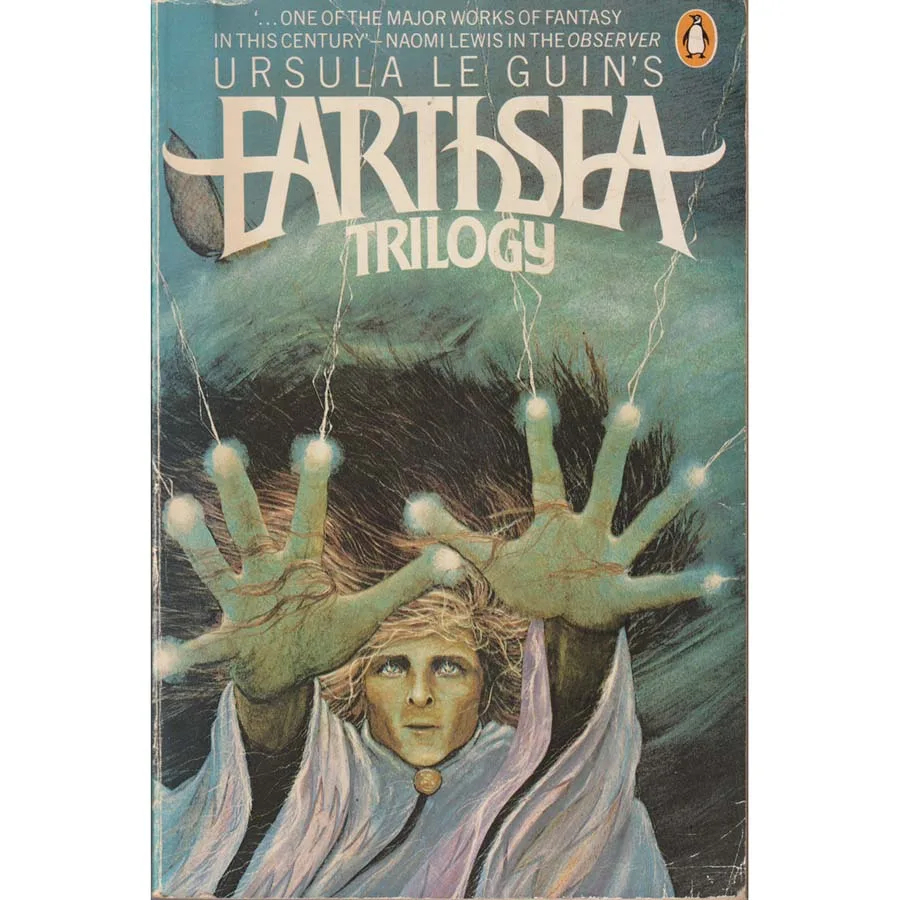
Publisher: Penguin
Format: Paperback
ISBN: 0140050930
The Earthsea Trilogy by Ursula K. Le Guin, published by Penguin in 1979, brings together the first three great Earthsea novels in one volume: a world of islands, wizards, dragons, ancient powers and the deeply inconvenient discovery that becoming wise usually involves making at least one catastrophic mistake first.
The collection contains:
A Wizard of Earthsea
The Tombs of Atuan
The Farthest Shore
Which is an excellent amount of Earthsea for one paperback.
Le Guin’s fantasy is very different from the louder variety.
There are no endless armies conveniently arriving over the hill every forty pages.
No one spends three chapters discussing the tax system of the elven provinces.
And magic is not simply a device for making explosions happen attractively.
In Earthsea, words matter.
Names matter.
Balance matters.
And using power carelessly has consequences.
This is bad news for young wizards.
The first book, A Wizard of Earthsea, introduces Ged, a gifted boy with enormous magical potential and exactly the amount of judgement one would expect from somebody young enough to be impressed by his own abilities.
Naturally, things go wrong.
Very wrong.
Ged’s story is not simply about learning spells.
It is about pride, fear, responsibility and the awkward business of discovering that the darkest thing chasing you may have rather more to do with yourself than you would prefer.
Which makes wizard training considerably less glamorous.
The Tombs of Atuan shifts perspective and setting, following Tenar, a young priestess raised within a dark and ancient religious system.
It is quieter, stranger and more claustrophobic than the first book.
There are underground passages.
Sacred rituals.
Silence.
Power.
And the gradual suspicion that a life defined entirely by other people’s rules may contain a structural flaw.
Le Guin was particularly good at this sort of thing.
She could write fantasy about magic while really writing about identity, freedom, power and culture.
Then, just when you become too comfortable, she adds darkness under the temple.
The Farthest Shore expands the scale again.
Something is going wrong with the world.
Magic itself appears to be failing.
Songs are being forgotten.
Crafts are being lost.
People are beginning to lose the meaning that once held their lives together.
Naturally, this requires a journey.
Fantasy always improves when someone has to cross dangerous water.
Earthsea is especially well supplied with dangerous water.
The archipelago setting gives the whole trilogy a distinctive character.
This is not one enormous medieval continent with a forest conveniently placed on the left.
Earthsea is made of islands.
Travel matters.
Distance matters.
Boats matter.
Weather matters.
And the sea is not scenery.
It is part of the structure of the world.
That gives the books a wonderfully spacious feeling.
Every island has its own customs.
Every journey changes the scale.
And every horizon suggests somewhere else.
Le Guin’s prose is also unusually elegant.
She does not over-explain.
She trusts the reader.
Her world feels old without requiring twelve appendices to prove it.
There are myths, languages, traditions and histories, but they sit inside the story rather than arriving in a wheelbarrow.
This is one reason the Earthsea books have aged so well.
They are fantasy novels, certainly.
But they are also books about growing up, mortality, identity, the responsible use of power and the fact that wisdom tends to arrive after it would have been most useful.
Published in this 1979 Penguin edition, the trilogy has the appeal of a proper vintage fantasy omnibus from the period when serious speculative fiction could be packed into a paperback and trusted to survive several owners, train journeys and shelves full of Tolkien.
For readers of fantasy, classic science fiction and fantasy, Ursula K. Le Guin, coming-of-age stories or anyone who likes imaginary worlds with depth rather than clutter, The Earthsea Trilogy is one of the major works of twentieth-century fantasy.
It is also ideal for anyone who prefers their wizards thoughtful, their dragons intelligent and their magical mistakes permanent.
Condition: Good. A sound used copy with normal signs of age and handling. Published in 1979, it has now survived long enough to become a vintage fantasy item in its own right.
ISBN: 0140050930.
Three classic Earthsea novels in one volume, full of magic, islands, dragons, shadow, silence and the persistent lesson that power is much easier to acquire than wisdom.
Sold by Crappy Old Books — where the world is imaginary, the consequences are real, and the dragons are probably better read than most people.
Keep browsing: See more Fantasy books Other books by Ursula le Guins
